
PayTo gives Australian businesses a more direct way to get paid. Customers approve a digital payment agreement, and approved payments can be processed in real time over the NPP, where the customer’s bank participates.
For decades, direct debit was the default way for Australian businesses to collect recurring payments. But this method was built for a batch-based world, where payments can take longer to clear and customers may have limited visibility over who is debiting their account.
Described as a digital successor to direct debit, PayTo supports real-time processing of approved payments. Built on the New Payments Platform, it can also provide richer payment data than BECS direct debit and visibility of customer payment agreements in participating online banking.
What is PayTo?
PayTo is a digital payment service that allows a business to initiate payments directly from a customer’s bank account with their authorisation. It is an initiative of Australian Payments Plus, the organisation that operates the NPP, and is offered through participating banks, financial institutions and payment service providers.
A PayTo Agreement sets out the payment terms a customer has approved, such as the amount, purpose and frequency. It can cover one-off, ad hoc or recurring payments.
PayTo Agreements can be viewed and managed by customers through their participating bank’s online banking, which may offer more visibility than some direct debit arrangements. Customers can review the details before authorising an Agreement and manage it once it is active.
What are the benefits of PayTo for businesses?
For businesses, PayTo can offer several advantages over traditional direct debit:
- Real-time payments: PayTo payments are processed over the NPP, which is designed to settle payments in real time.
- Real-time payment status: businesses can receive payment status notifications in real time when payments succeed or fail.
- Account verification: businesses can use PayID or account details to help confirm a customer’s account when setting up PayTo.
- Reconciliation support: PayTo allows more information to be included with payments, helping businesses match and reconcile transactions, depending on the business’s own systems.
- Visibility: businesses can be notified when customers pause or cancel their PayTo Agreements.
- Customer control: customers can view and manage PayTo Agreements through participating online banking.
- An alternative to card payments: PayTo provides an account-to-account payment option for suitable payment flows.
- Flexible access: businesses can access PayTo through an API or the Monoova Client Portal, depending on their requirements.
For businesses reviewing their payment mix following changes to card surcharging, read Multi-Rail Payments & Australia’s Surcharge Ban.
How does PayTo work in Australia?
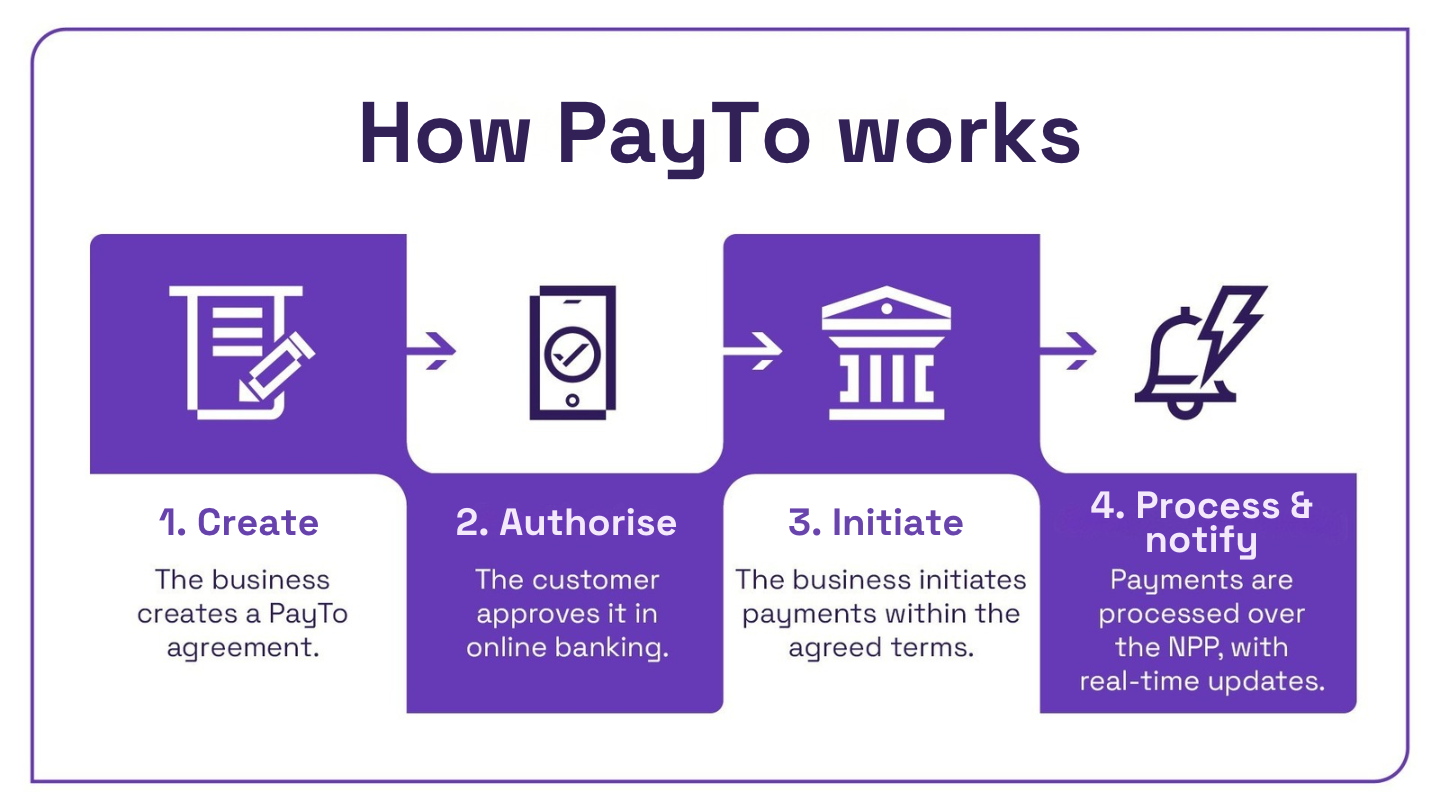
To set a customer up with PayTo, a business creates a PayTo Agreement using their PayID or BSB and account number. The Agreement includes the relevant payment terms, such as the amount, purpose and frequency. It is then sent to the customer’s participating online banking for them to review and authorise.
Once the Agreement has been authorised, the business can initiate payments according to its approved terms. These may be one-off, ad hoc or recurring payments.
Payments are processed over the NPP in real time, with businesses receiving real-time payment status notifications. The Agreement remains available in the customer’s participating online banking, where they can view and manage it.
PayTo vs direct debit: what's the difference?
Both PayTo and direct debit both allow businesses to collect funds from a customer’s bank account with their permission, but they operate differently.
Direct debit runs through the Bulk Electronic Clearing System, known as BECS, which processes payments in batches.
PayTo operates over the NPP and is designed to process payments in real time. It can also provide real-time payment status notifications and allow customers to view and manage their Agreements through participating online banking. PayTo also supports data-rich payment messaging. This can help businesses match and reconcile transactions, depending on their own systems and processes.
PayTo vs direct debit at a glance
What does the BECS transition mean for businesses?
BECS as powered Australian direct debits and credits for decades, but Australia’s payments industry is continuing to modernise account-to-account payments. In November 2023, the Australian Payments Network, known as AusPayNet, announced June 2030 as the target end date for BECS.
In December 2025, AusPayNet removed that target date to allow more time to address industry challenges and develop a clear roadmap for the future of account-to-account payments in Australia. AusPayNet confirmed in July 2026 that this position remained unchanged.
The industry’s intention to transition away from BECS towards modern alternatives such as the NPP remains, but there is currently no target end date for BECS decommissioning.
For businesses, this creates an opportunity to review existing BECS-dependent payment processes and consider where PayTo and other NPP-based services could fit.
How are Australian businesses using PayTo?
PayTo can support businesses that collect customer-authorised payments, including subscriptions, loan repayments, insurance premiums and account funding for investment or digital wallet platforms.
It can be used for one-off, ad hoc and recurring payments, depending on the terms the customer has authorised. Potential use cases include:
- Subscription and membership payments
- Loan repayments and instalments
- Insurance premiums
- Utility and telecommunications payments
- Investment and digital wallet funding
- Ecommerce and other one-off payments
For businesses reviewing the payment methods they offer, PayTo can sit alongside other payment options rather than replacing every existing payment flow.
Wagepay: an early PayTo adopter

Earned wage access provider Wagepay was among the early adopters of PayTo through Monoova.
Within the first three weeks of going live in 2023, more than 3,000 PayTo Agreements had been issued to Wagepay customers. Wagepay founder Tony Chan quoted
“We see clear benefits in moving our customers onto PayTo so they can enjoy better visibility and control over their money. For us as a business, reconciliations are easier too…”
*Results vary between businesses and are not a guide to future performance.
How Monoova powers PayTo in Australia
Monoova was named in Australian Payments Plus’s June 2022 announcement as one of the first payment service providers preparing to offer PayTo to merchant and business customers. Businesses can access Monoova’s PayTo solution through an API or the Client Portal, depending on how they want to manage their payment workflows.
PayTo via API
Businesses can integrate PayTo through Monoova’s API to incorporate PayTo Agreements and payments into their existing workflows.
This option is designed for businesses looking to embed PayTo within their platform or payment experience.
PayTo through the Client Portal
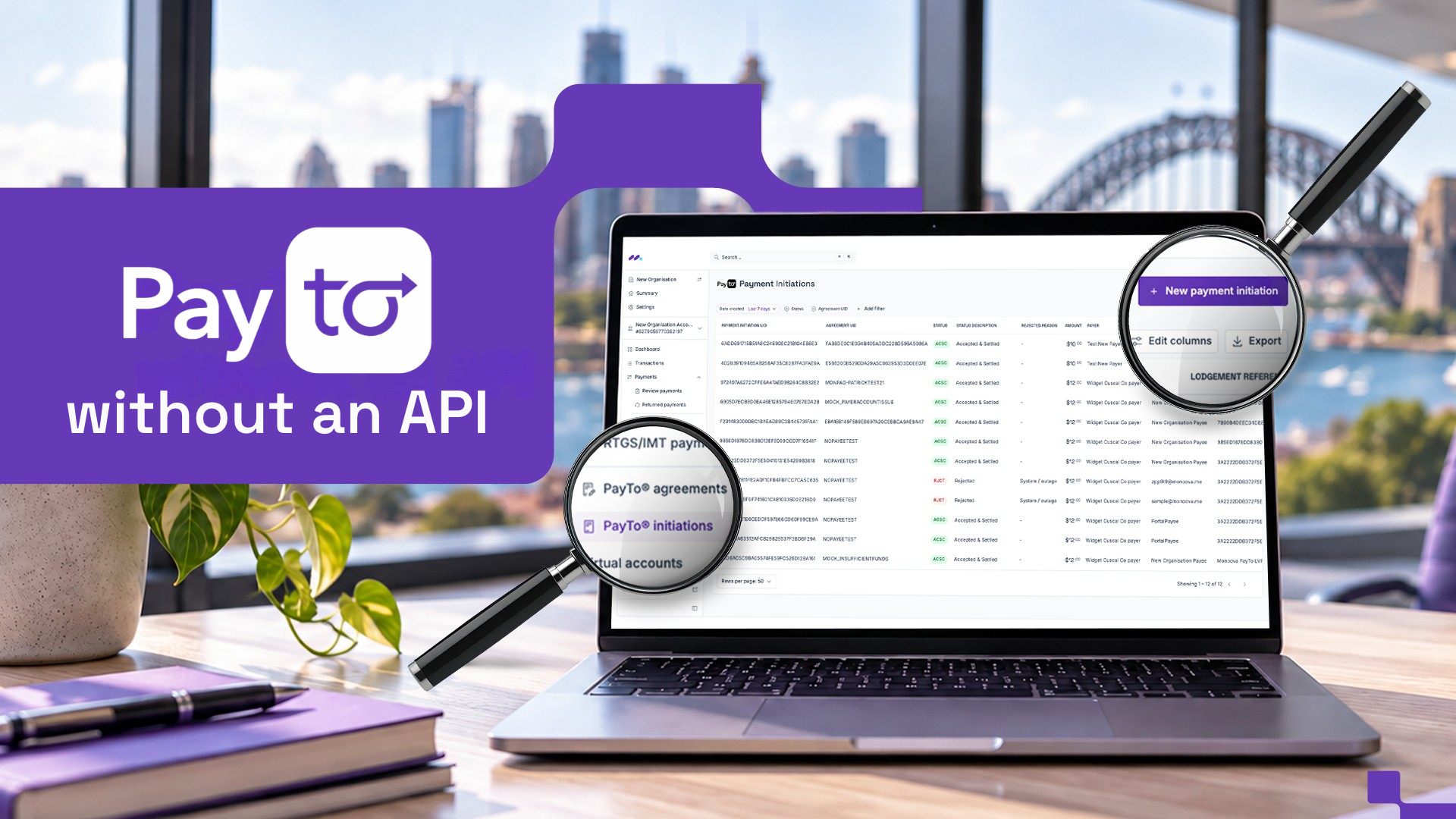
For businesses that don’t require API integration, Monoova’s Client Portal provides a web-based interface for creating PayTo Agreements, initiating payment requests and viewing their status. This can give businesses another way to access PayTo without integrating directly through an API.
Learn more about getting started with PayTo through the Monoova Client Portal.
PayTo Scheduler
For recurring payments, Monoova’s PayTo Scheduler allows businesses to schedule payments in advance.
Schedules can be added to new or existing PayTo Agreements, with payments initiated according to the schedule and the conditions authorised by the customer.
Want to know more about introducing PayTo for your business? Speak with a member of our team.
FAQs
Q1: What is PayTo?
A1: PayTo is a digital payment service that allows businesses to initiate payments directly from a customer’s bank account with their authorisation. PayTo Agreements can support one-off, ad hoc or recurring payments.
Q2: How does PayTo work in Australia?
A2: A business creates a PayTo Agreement setting out payment details such as the amount, purpose and frequency. The customer reviews and authorises the Agreement through their participating online banking before the business can initiate payments according to the approved terms.
Q3: What is the difference between PayTo and direct debit?
A3: Direct debit operates through the batch-based Bulk Electronic Clearing System (BECS), while PayTo operates over the New Payments Platform (NPP) and is designed to process approved payments in real time. PayTo can also provide real-time payment status notifications and allow customers to view and manage their Agreements through participating online banking.
Q4: What are the benefits of PayTo for businesses?
A4: PayTo can provide real-time payment processing and status notifications, richer payment data to support reconciliation and greater visibility of customer payment Agreements. It also gives businesses an account-to-account payment option for suitable payment flows.
Q5: Can businesses use PayTo without API integration?
A5: Yes. Businesses can access PayTo through Monoova’s Client Portal to create PayTo Agreements, initiate payment requests and view their status without integrating directly through an API.